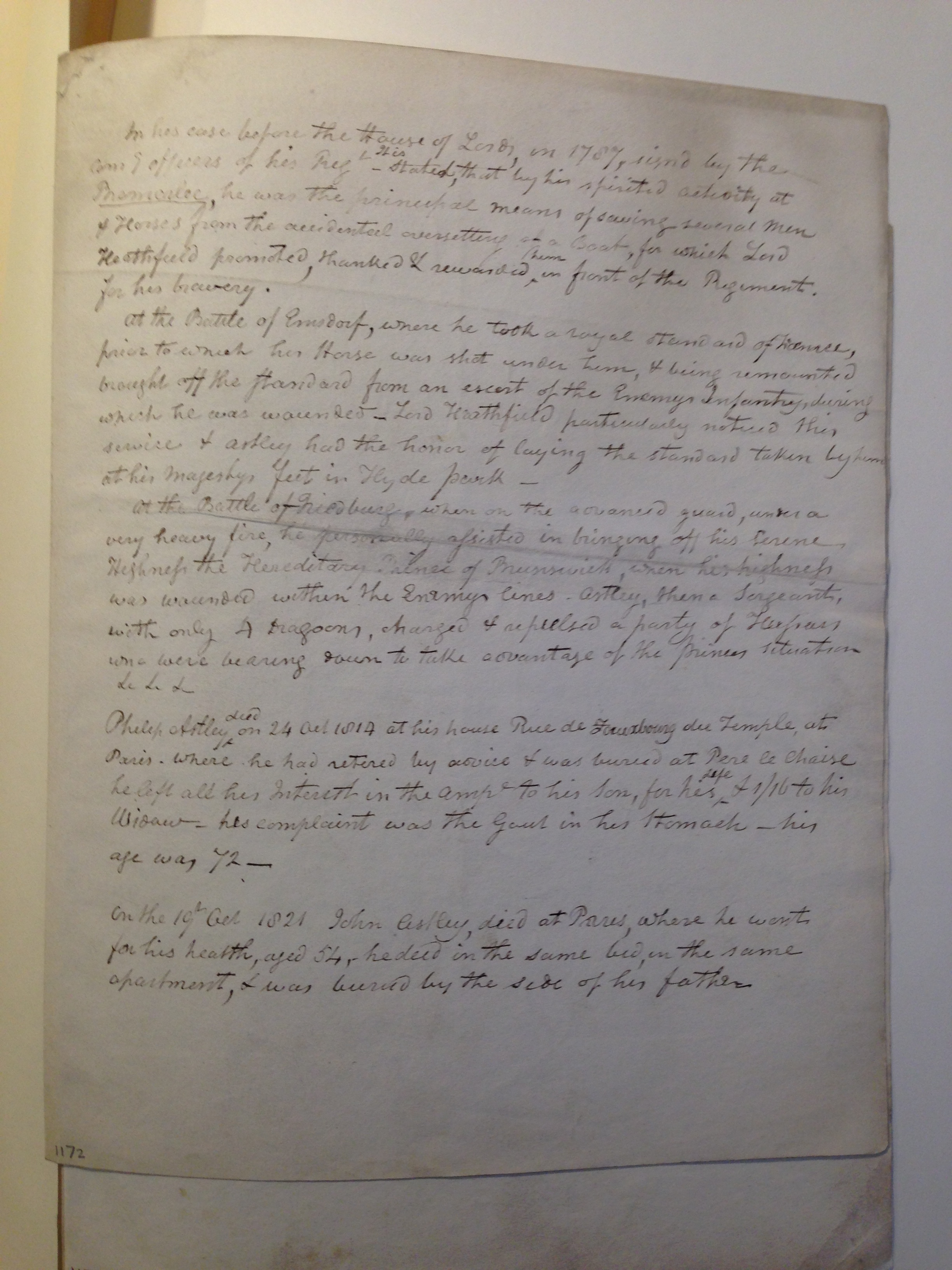
Transcription
In his case before the House of Lords, in 1787, signd [signed] by the
Com [committee] & officers of his Roy [Royal] [^ His] [Highness] – stated, that by his spirited activity at
Bremerlee, he was the principal means of saving several men
& Horses from the accidental oversetting of a Boat, for which Lord
Heathfield promoted, thanked & rewarded [^ him] in front of the Regiment.
for his bravery.
At the Battle of Emsdorf, where he took a royal standard of France,
prior to which his Horse was shot under him, & being remounted
brought off the standard from an escort of the Enemys [Enemy’s] Infantry, during
which he was wounded – Lord Heathfield particularly noticed this
service & Astley had the honor of laying the standard taken by him
at his Majestys [Majesty's] feet in Hyde Park —
At the Battle of Friedburgh, when on the advanced guard, under a
very heavy fire, he personally assisted in bringing off his [serene(?)]
Highness the Hereditary Prince of Brunswick, when his highness
was wounded within the Enemy lines. Astley, then a sergeant,
with only 4 Dragoons, charged & repulsed a party of Hussars
who were bearing down to take advantage of the princes [prince’s] situation
&c &c &c
Philip Astley [^ died] on 24 Oct 1814 at his house Rue du Fauxbourg du Temple, at
Paris. Where he had retired by advice & was buried at Pere la Chaise
he left all his Interest in the Amp [Amphitheatre] to his Son, for his [^ life] & 1/10 to his
Widow – his complaint was the gout in his stomach – his
age was 72 —
On the 19th Oct 1821 John Astley, died at Paris, where he went
for his health, aged 54, he died in the same bed, in the same
apartment, & was buried by the side of his father